Saernieprieve 25 –njoktjen/voerhtjen 2026 
“Five Years Toward a New Museum Order” was the title of Dávvirat Duiskkas’ (DD’s) recap conference at Scandic Alta, Norway, March 23-25. No badly cooked reindeer roast could refute the success. The conference solidly confirmed what we had only dared to hope for: That the project has contributed to more informed and rebalanced relationships, from the beginning in the fall of 2021, when we did not yet know how we would be received by German museums with Sámi collections, and if they would receive us at all, to the magnificent gathering of almost 70 colleagues from home and abroad, minority and majority institutions, at the Alta conference. Seemingly paradoxical, but not really, the long-awaited experience by the Sámi museums of feeling recognized as an equal, at least from the perspective of the ones in Norway, was firstly evoked by German museums, not Norwegian or Nordic ones. Or as summed up by steering group leader Birgitta Fossum in the summarizing panel discussion: The big difference is that German museums acknowledge their own colonial history!
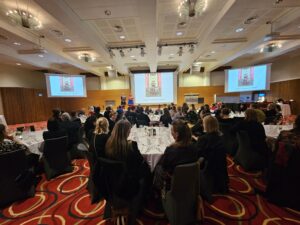
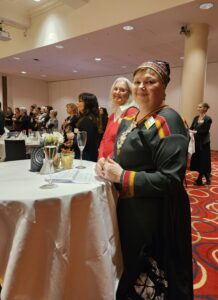
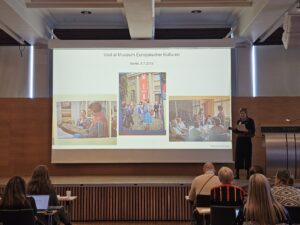
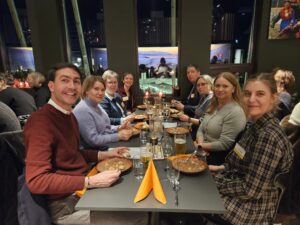
The conference opened Monday evening with a reception, keynote and celebration dinner. Paul Bendikk Jåma, member of the Norwegian Sámi Parliament’s Executive Council welcomed the guests while Alexis Mocio-Mathieu from UNESCO’s Intergovernmental Committee for Promoting the Return of Cultural Property to its Countries of Origin or its Restitution in case of Illicit Appropriation (ICPRCP), introduced the audience to the committee’s work. Elizabeth Tietmeyer, the director of Museum Europäischer Kulturen (MEK) in Berlin, was the keynote speaker. For three years (2022-2025) Tietmeyer has led a provenance research project on MEK’s Sámi collection, and the lecture focused on that exemplary work. The dinner was hosted by Anne May Olli and Eva Dagny Johansen. Anne May is the director of RiddoDuoattarMuseat, the region’s Sámi museum (a consolidated unit), while Eva Dagny is a curator at Alta Museum and the head of the Sámi section of the Norwegian Museums Association. The local juoigi Johan Ivvar Gaup moved everyone with his musical entertainment.
Tuesday was dedicated to a recaption of the project. Originally the conference was going to mark the end of the project, but thankfully it has been extended for another two years (June 2028). It would be a shame to stop with such momentum built up. However, the project’s focus will shift from generalized mapping to specialized provenance research and with the aim of restituting some of the objects.
Project leader Cathrine Baglo and steering group leader Birgitta Fossum opened the conference on behalf of Dávvirat Duiskkas. Baglo summarized the project and its findings. German museums and heritage institutions contain around 3600 Sámi objects and among these are 15 sacred drums. Fossum on the other hand spoke about the significance of the project for the Sámi museums. Marie-Theres Federhofer who is a professor in German literature and cultural studies at UiT-The Arctic University of Norway, continued with a presentation on the contemporary and historical relations between Sápmi and Berlin. It was in fact Federhofer, at the time a Henrik Steffens professor at Humboldt Universität, who invited Aili Keskitalo, at the time the Norwegian Sámi Parliament President,[i] to Berlin in July 2019 to give a lecture. When Keskitalo asked to also visit the Sámi collections at Museum Europäischer Kulturen (MEK) with a delegation of Sámi museum staff and cultural bureaucrats, the seedling to Dávvirat Duiskkas was sown.
After lunch the session “Synergies and significance” took place. Birgitta Fossum spoke again, this time of the significance of the return of Freavnantjahken gievrie/the Freavna mountain’s drum from Meiningen to Saemien Sijte South Sámi Museum for the local community. Barbara Plankensteiner and Anna-Sophie Laug spoke about Sámi heritage and its representation in the Museum am Rothenbaum – Kulturen und Künste der Welt (MARKK) in Hamburg – the MARKK collection is the largest in Germany, while Eeva-Kristiina Nylander spoke of the exhibition/project room “Áimmuin: Re-Connecting Sámi Heritage” at Museum Europäischer Kulturen. Moreover, Nylander acquainted the audience with the concept of “propatriation” as it has been increasingly used in Canada and the United States since 2010 – proactive, collaborative work that acknowledges the past while creating a productive future. [ii]
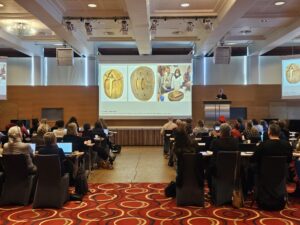
In the late afternoon the session “Reflections from project owners and partners” took place. Lisa Dunfjeld-Aagård, Harrieth Aira, Thomas Ole Andersen, Lisa Vangen, Elle Bals, and Hanna Maaria Kiprianoff presented on behalf of the six museums or consolidated museum units that are managed by the Norwegian Sámi parliament, the owner of DD. Sarah Nelly Friedland from Reiss-Engelhorn Museen in Mannheim and Richard Hölzl from Museum Fünf Continente in München presented from the perspective of German museums.
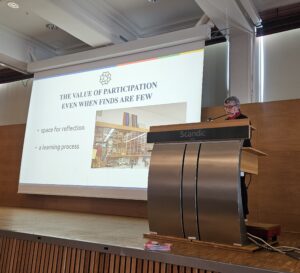
“To see that Sámi collections have a place in European collections has made me proud”, was one statement. “The project has been both educational and emotional. There has been much silence about the drums in the Lule Sámi area”, was another. “We need to step up provenance research, discuss repatriation, post-colonial representation, the archaeology of meaning, and un-learning”, was a third. The first conference day ended with the summarizing panel “So far and forward” led by the before mentioned Aili Keskitalo. She is now a (Norwegian) government nominated member of the United Nation’s Permanent Forum on Indigenous Issues.
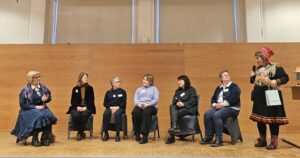
Day two (Wednesday) of the conference was titled “Toward new museum practices and a new museum order”. The speakers were Jelena Porsanger (RiddoDuoattarMuseat -Sámiid Vuorká-Dávvirat in Kárášjohka/Karasjok in Norway), Anni Guttorm (Siida Sámi Museum in Aanaar/Inari in Finland), Elisabeth Pirak Kuoljok (Ájtte Sámi Museum in Jåhkåmåhkke/Jokkmokk in Sweden) and Gro Birgit Ween (Museum of Cultural History in Oslo).
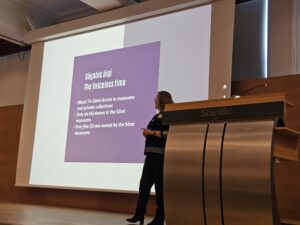
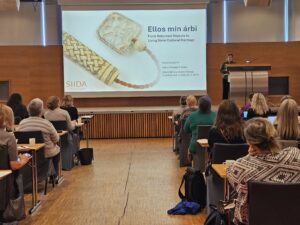
Pirak Kuoljok offered perspectives from the Swedish side. She addressed some of the challenges that Ájtte faces, such as ongoing efforts to return a Sámi drum from Museum of European and Mediterranean Civilisations in Marseille, the renewed dialogue with the Nordic Museum in Stockholm to return Sámi artefacts, and the struggle to balance a traditional museum role with Sámi perspectives and expectations. Finally Ween shared information on the new project MORE – Museum Objects and Reconciliation Ethics Collaborations over post-repatriation reparations in Sápmi (2026-2029).[iv]
After lunch Wednesday half of the group headed home while the other half continued by bus to the village of Guovdageaidnu/Kautokeino 130 km SW of Alta. The village is the administrative center of the municipality with the same name; Norway’s largest by area and one of the coldest in wintertime. The municipality is home to several Sámi cultural and educational institutions. It is the largest reindeer herding municipality in Norway and it has the largest proportion of people registered in the Sámi electoral roll in relation to its population of 2 886. Among other important historical events, Kautokeino was the center of the religious -political Kautokeino Rebellion of 1852 and the movement against the development of the Alta-Kautokeino waterway which culminated in the Alta controversy in the 1970s early 1980s. As a result, Sámi indigenous rights were finally put on the Norwegian political agenda.
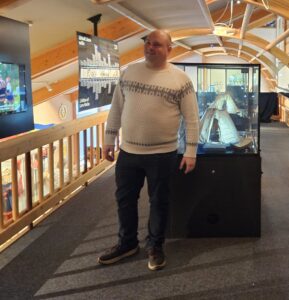
In Kautokeino we visited Čoarvemátta, the new shared facility (2024) between Beaivváš Sámi Našunálateáhter/ Beaivváš Sámi National Theater (1981) and the Sámi High School and Reindeer Herding School. The facility is designed by Norway’s most famous architectural company, Snøhetta, and the name comes from the Sámi words “čoarvi” and “mátta”, meaning “horn” and “root”, which characterize the strongest part of the reindeer antler – often used in duodji, traditional Sámi crafts and handicrafts. After the visit we split into two groups. Half the group visited Juhl’s Silver Gallery, a famous silversmith workshop established by the German Danish couple Regine and Frank Juhl who were inspired by Sámi artistic style in their work, while the other half visited the new permanent exhibition on JáhkošLásse/Lars Jakobsen Hætta at Guovdageainnu gilišillju/Kautokeino Municipal Museum, a consolidated unit in RDM (RiddoDuottarMuseat). Then we switched.
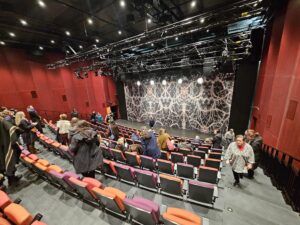
Lars Jakobsen Hætta (1834-1896) was a Sámi reindeer herder born in Kautokeino. He was sentenced to death for his involvement in the Kautokeino rebellion in 1852, but the sentence was later changed to life imprisonment.[v] Hætta served his sentence at Akershus Fortress in Oslo until he was pardoned in 1867. While imprisoned in Oslo, he served as an informant for Jens Andreas Friis, who was a teacher and from 1874 professor of Sámi language at the University of Kristiania which was the name of Oslo at the time. Moreover, Hætta started translating the Bible into North Sámi and crafting miniature models of everyday objects in a reindeer herding household, partly for didactic reasons but partly also as a memory work.[vi] These models are today scattered around several museums in Norway and abroad including the Norwegian Folk Museum, the Historical Museum in Bergen, the National Museum of Denmark and the Pitt-Rivers Museum in Oxford. Some of the models were returned to Kautokeino Municipal Museum through Bååstede (2012-2019), the restitution project between the Norwegian Folk Museum and Museum of Cultural History in Oslo and the Sámi museums in Norway. Other miniatures have been tracked and borrowed from elsewhere. The collection constitutes the new permanent exhibition that we had the pleasure of visiting.
After dinner at Kautokeino Thon Hotel the group returned to Scandic Alta and departures the next day. Dávvirat Duiskkas’ recap conference was intense but as mentioned initially, successful beyond expectations. As the project leader I am of course partial, yet I hope that the kind words offered by the UNESCO delegate resonates in others too: “I was [..] impressed by the profoundly warm atmosphere that has accompanied your work since the inception of this project, and which will continue over the next two years. This spirit, grounded in deep mutual respect among all parties involved, plays a vital role in fostering constructive dialogue and in easing sensitivities around the discussions.”
We could not have done it without you. Many, many thanks.
Mannet dearvan! Live well!
Cathrine Baglo
References
[i] Aili Keskitalo (in North Sámi Biehttar Heaikka Elle Máreha) was the president of the Norwegian Sámi Parliament from 2005-2007, from 2013-2016 and from 2017-2022. She represented the Norwegian Sámi Association (NSR).
[ii] Moore, E. 2010. Propatriation: Possibilities for Art after NAGPRA. Museum Anthropology, 33: 125-136. https://doi.org/10.1111/j.1548-1379.2010.01091.x. See also Nash, S. 2021. How Museums Can Do More Than Just Repatriate Objects. SAPIENS [digitital magazine], May 13. https://www.sapiens.org/archaeology/propatriation-nagpra/
[iii] https://siida.fi/en/ellos-min-arbi/
[iv] https://www.khm.uio.no/english/research/projects/more/
[v] For further information on Hætta, see for example, https://en.wikipedia.org/wiki/Lars_H%C3%A6tta and Oskal N, Johansen Ijäs, J and Bjørklund, I. 2019 (ed.) Erindringer – samiske beretninger om Kautokeino-opprørets bakgrunn, etikk og moral.
[vi] Monica Grini who participated in the Alta conference has written about the Hætta miniatures in English; The Art of Returning Home. Lars Hætta’s Miniature Duodji in The Routledge Companion to Art and Challenges to Empire (2025). https://www.taylorfrancis.com/chapters/edit/10.4324/9781003562672-3/art-returning-home-monica-grini